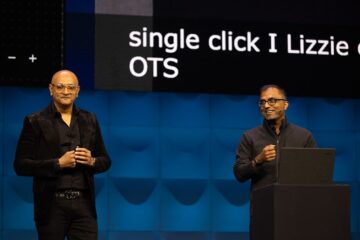


Security was a key focus at the launch of the latest AI platform by Nvidia, with five security vendors announcing protection for Nvidia’s agentic AI stack. This is a significant development as cybersecurity professionals now rank agentic AI as the top attack vector for 2026. However, only 29% of organizations feel fully prepared to deploy these technologies securely. With machine identities outnumbering human employees in the average enterprise, the need for robust security measures is clear. Attacks exploiting public-facing applications have surged by 44%, accelerated by AI-enabled vulnerability scanning.
Nvidia CEO Jensen Huang emphasized the importance of securing agentic systems within the corporate network during his keynote at GTC. Nvidia has defined a unified threat model that accommodates the strengths of various security vendors. Notable collaborators include Google, Microsoft Security, and TrendAI. The article outlines the security offerings from five vendors, along with their deployment commitments and a reference architecture for security governance.
The five-layer governance framework outlined in the article covers agent decisions, local execution, cloud operations, identity, and supply chain. Each layer requires specific security measures to mitigate risks effectively. Vendors such as CrowdStrike, Palo Alto Networks, JFrog, Cisco, and WWT offer solutions to address different aspects of security governance. Security leaders can evaluate these vendors based on their specific needs and existing security infrastructure.
The article highlights the importance of intent-aware controls in securing AI agents to prevent unauthorized access and malicious activities. The blast radius of compromised AI agents is significantly larger than that of human credentials, making robust security measures essential. Vendors like CrowdStrike embed security controls at multiple enforcement points within the Nvidia OpenShell runtime to enhance protection.
Overall, the collaboration between Nvidia and security vendors aims to transform SOCs into autonomous fighting machines capable of detecting and responding to threats at unprecedented speeds. By implementing the right security measures and governance frameworks, organizations can enhance their security posture and mitigate the risks associated with agentic AI technologies.
Each vendor in the security stack offers unique capabilities to address different aspects of security governance. Security leaders are advised to evaluate all five vendors based on their specific requirements and threat models to enhance overall security posture.
Cisco’s Secure AI Factory with AI Defense extends security measures to Nvidia BlueField DPUs and the OpenShell runtime, providing additional guardrails to protect against potential threats.
In deployments involving multiple vendors, Cisco AI Defense and Falcon AIDR function as parallel guardrails: AIDR enforces within the OpenShell sandbox, while AI Defense enforces at the network perimeter. If a threat manages to evade one guardrail, it will still be intercepted by the other.
Palo Alto Networks utilizes Prisma AIRS on Nvidia BlueField DPUs as part of the Nvidia AI Factory validated design. This offloads inspection to the data processing unit at the network hardware layer, below the hypervisor and outside the host OS kernel. The integration between Palo Alto and Nvidia is seen as a validated reference architecture pairing rather than a tightly coupled OpenShell runtime integration. Palo Alto intercepts east-west agent traffic on the wire, while CrowdStrike monitors agent process behavior within the runtime.
JFrog introduced the Agent Skills Registry, which serves as a system of record for MCP servers, models, agent skills, and agentic binary assets within Nvidia’s AI-Q architecture. Early integration with Nvidia has been validated, with full OpenShell support in active development. JFrog Artifactory will function as a governed registry for AI skills, scanning, verifying, and signing every skill before agents can utilize it.
Worldwide Technology launched a Securing AI Lab within its Advanced Technology Center, built on Nvidia AI factories and the Falcon platform. WWT’s vendor-agnostic ARMOR framework serves as a pre-production validation and proving-ground capability to test the integrated stack’s behavior in a live AI factory environment before deployment.
CrowdStrike fine-tuned Nvidia Nemotron models on first-party threat data and operational SOC data from Falcon Complete engagements. Internal benchmarks show faster investigations, higher triage accuracy, and improved performance in generating investigation queries within Falcon LogScale. Kroll, a global risk advisory and managed security firm, confirmed these results in production.
Several enterprises have already deployed the CrowdStrike-Nvidia stack for Agentic SOC services, with positive feedback from EY, Nebius, CoreWeave, and Mondelēz North America. These deployments showcase the effectiveness of the integrated security solutions.
While the five-vendor stack provides advanced security capabilities, there are still gaps in agent-to-agent trust, memory integrity, and registry-to-runtime provenance that need to be addressed. Implementing multiple vendors across different enforcement layers introduces operational overhead that must be managed effectively to ensure seamless security operations.
Preparing for Your Next Board Meeting: Essential Steps for Every CISO
Let’s talk about the real deal here. Running all five simultaneously from the get-go is not just a simple configuration task – it’s a full-blown integration project. So, make sure you budget accordingly for this massive undertaking.
Now, before you walk into that board meeting, here’s what you should be able to confidently say as a CISO who means business:
“We’ve thoroughly audited every single autonomous agent against the five governance layers. Here’s what we’ve got in place, and here are the five crucial questions we are grilling our vendors with.”
If you can’t make that statement with confidence right now, it’s not just about being behind schedule. It’s about the lack of a schedule altogether. Five vendors may have just dropped the blueprint, but the real work lies in putting it all together.
So, here are four critical tasks you need to tackle before facing your next board meeting:
-
Conduct the five-layer audit. Round up every autonomous agent your organization is currently running. Match each one against the five governance layers outlined above. Highlight which vendor questions you can answer and which ones you’re still scratching your head over.
-
Tally up the unanswered questions. If you’ve got three or more hanging in the air, that spells trouble – ungoverned agents are lurking in production. This number is not just a backlog item; it’s your board’s wake-up call.
-
Put those three open gaps to the test. Challenge your vendors head-on: How do they handle trust between agents in MCP delegation chains? How do they spot memory poisoning in agent stores? Can they prove a cryptographic link between registry scans and runtime loads? The truth is, none of the vendors at GTC had all the answers. It’s not about pointing fingers; it’s about forging the path for the next phase of agent security.
-
Establish your oversight model before diving into scalability. As Bernard wisely put it, keep both agents and humans in the loop. When you’re running at 5x speed with 96% accuracy, errors come flying in faster than your average SOC can handle. The kill switches and fail-safes must be ready before you hit that scale, not after the damage is done.
Remember, the scaffolding is just the beginning. It’s vital, but it’s not the end game. Your security stance will only transform if you treat the five-layer framework as a practical tool, not just another slide in the vendor presentation.