San Rafael, United States, October 19th, 2026, CyberNewswire
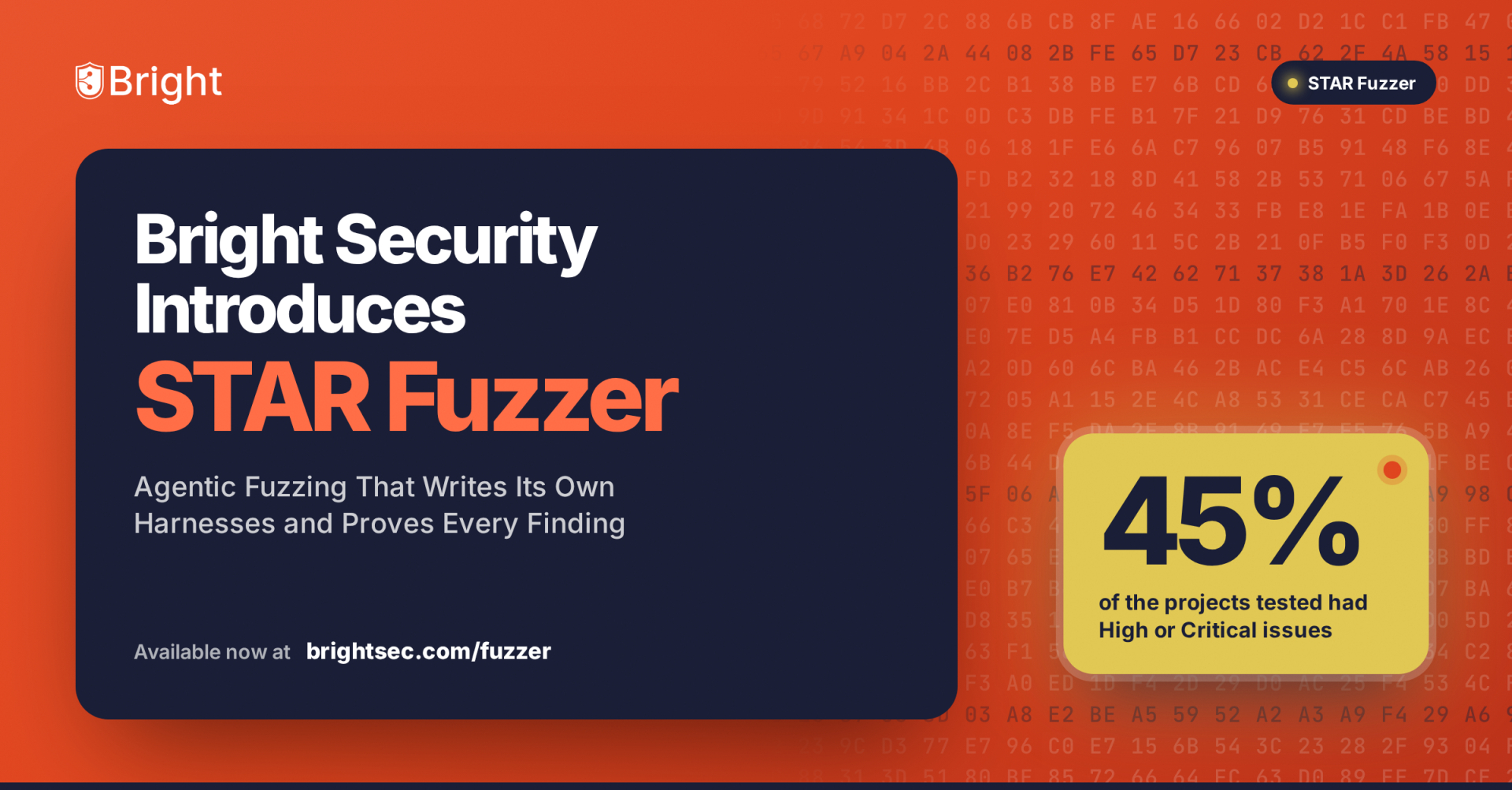
Built on an evolutionary engine first released in 2018, STAR Fuzzer by Bright Security finds crashes, memory exhaustion and memory-safety bugs in security-critical code without a running application. In its first open source research run, it found High or Critical issues in 45% of the projects tested, and in its first month of availability it produced ten published findings in eight projects, including the Crystal standard library, htop and RIOT OS.
Bright Security, the Agentic Offensive Application Security company, today announced the official launch of STAR Fuzzer, an agentic application fuzzer that automatically identifies security-critical functions, generates a fuzzing harness for each one, searches for faults with an evolutionary algorithm, and delivers every confirmed finding with a byte-exact payload that reproduces it. STAR Fuzzer is a self-contained mode of the Bright STAR platform and is available now at brightsec.com/fuzzer.
Agentic fuzzing applies AI agents to the parts of fuzzing that have traditionally required a specialist: choosing what to test, writing the harness, and deciding which crashes matter. STAR Fuzzer uses AI for those steps and an evolutionary search engine for the fuzzing itself, so the parts that need judgment are automated and the search stays fast, repeatable and evidence based.
Why Fuzzing Needed a New Approach
Coverage-guided fuzzers such as AFL++ and libFuzzer are proven and widely used, and programs like Google’s OSS-Fuzz have shown how much they can find. But they depend on people to write and maintain a harness for every target and to triage the crashes that come back. That cost has kept fuzzing concentrated in specialist teams and a subset of critical projects.
Other testing approaches don’t fill the gap. Dynamic application security testing (DAST) tests what an attacker can reach over HTTP, so it rarely exercises the parsing and processing code behind input validation. LLM-based pentesting is effective at known vulnerability patterns but tends to look where a model expects bugs to be. The result is a class of outage-level and memory-safety defects, often triggered by tiny malformed inputs, that most AppSec programs never test for.
How STAR Fuzzer compares with traditional coverage-guided fuzzers (such as AFL++ and libFuzzer) and DAST:
- What it Tests: Traditional fuzzers test functions exposed through a hand-written harness. DAST tests running applications over HTTP. STAR Fuzzer tests security-critical functions on untrusted-input paths, chosen automatically.
- Harness: Traditional fuzzers need harnesses written and maintained by engineers. DAST doesn’t use one. STAR Fuzzer generates a harness per function with AI, then verifies it reaches its target.
- Search: Traditional fuzzers use coverage-guided mutation. DAST sends request-level attack payloads. STAR Fuzzer uses a structure-aware evolutionary search guided by coverage and multiple fitness signals.
- Running App Needed: Traditional fuzzers, no. DAST, yes. STAR Fuzzer, no.
- Triage: Manual for traditional fuzzers and built into the scanner for DAST. STAR Fuzzer triages automatically for reachability and impact.
- Output: Traditional fuzzers return crash inputs and logs. DAST returns a vulnerability report. STAR Fuzzer delivers the file, function and byte-exact payload in a pull request.
- Fix Validation: Traditional fuzzers need a manual re-run and DAST needs a rescan. With STAR Fuzzer, teams replay the payload.
Finding the Bugs LLMs Miss
Ask an LLM to audit a parser and it will find the bug classes it already knows from training. The zero-days that survive for years in mature, widely deployed code are the ones that match no known pattern. STAR Fuzzer uses AI to choose targets and build harnesses, but the search that finds the bugs is not an LLM. It doesn’t read the code or guess where a bug might be. It runs the program millions of times, observes what actually happens, and keeps whatever pushes the target into code it hasn’t reached yet.
In Back to the Fuzzer II: Finding the Bugs LLMs Miss, Bright Security CTO Bar Hofesh gives four reasons LLM code review does not replace fuzzing for zero-day discovery:
- Scale: A single fuzzing campaign runs 1 million to 10 million concrete inputs against the compiled target. At about 2,000 tokens per reasoned test case, matching one million executions with an LLM would take about two billion tokens for one target, and each of those test cases would still be a prediction.
- Speed and Ground Truth: A persistent harness runs hundreds to a few thousand inputs per second per worker, across several parallel workers, so one million executions take minutes to tens of minutes. One LLM reasoning pass over one hypothesis takes several seconds, so one million would take months. The fuzzer also observes real behavior, such as a sanitizer reporting a heap read one byte out of bounds. An LLM has to predict how compiled code behaves, including struct layouts, integer widths, allocator behavior and build flags that aren’t visible in the source.
- Coverage: STAR Fuzzer’s libxml2 harness reaches about 13,600 code regions in a 5-million-execution run. Coverage feedback shows which regions each input reached, and inputs that reach new code become starting points for deeper search. Code review has no equivalent signal for how much of a large parser it has actually covered.
- The Unexpected: LLMs, code reviewers and static analyzers look for the same known patterns, so in mature code most of those bugs are already fixed. The fuzzer has no expectations about where a bug should be. The target’s own behavior decides what is interesting.
Reproducibility is the other difference. Many plausible-looking LLM findings don’t reproduce, and maintainers need a reproducer before they can act.
STAR Fuzzer, developed by Bright Security, is a tool that finds vulnerabilities through fuzzing and reproduces them in a controlled environment before reporting them. The tool works by driving any target through a small harness over IPC, allowing code written in various languages to be tested. It uses structure-aware parsing without the need for per-target grammar files, enabling mutations that get past initial checks to focus on deeper logic. The tool evolves with exact replay, allowing for precise reproduction of findings.
In open-source testing, STAR Fuzzer identified High or Critical issues in 45% of projects tested, with 37% of vulnerable projects part of Google’s OSS-Fuzz program. Within its first month, the tool discovered and reported ten vulnerabilities in projects written in C, Go, JVM languages, and Crystal, all replayed in fresh containers before filing.
STAR Fuzzer is designed for teams handling untrusted input below the HTTP layer, such as applications processing uploaded files, parsers, serialization code, and non-web software. It supports multiple languages and can run within the customer’s environment without the need for a running application or cloud scanner. Harness execution in persistent mode is significantly faster than running a new process per input.
Executive perspectives from Bright Security emphasize the importance of automated fuzzing in finding critical bugs efficiently, especially in code written rapidly, including AI-generated code. The tool helps security teams confirm static analysis findings and address vulnerabilities promptly. STAR Fuzzer’s success in identifying real bugs in mature open-source projects underscores its effectiveness in enhancing code security.
STAR Fuzzer is now available as a component of Bright STAR, offering teams a comprehensive solution for identifying and addressing vulnerabilities in their codebase. To explore more and schedule a demonstration, visit brightsec.com/fuzzer.
Frequently Asked Questions:
Unveiling Agentic Fuzzing: Agentic fuzzing harnesses AI agents to streamline the decision-heavy aspects of fuzzing: determining which functions to test, creating and validating harnesses, and evaluating results. The actual fuzzing process is carried out by a search engine that alters inputs to trigger faults.
Setting STAR Fuzzer Apart from AFL++ or libFuzzer: While AFL++ and libFuzzer are fuzzing engines that require engineers to create a harness for each target and manually handle crash triage, STAR Fuzzer by Bright Security automates target selection, harness generation and validation, fault triage for reachability and impact, and delivers findings through a pull request with a reproducible payload.
Exploring LLMs for Zero-Day Vulnerabilities in Parsers: LLMs excel at identifying known bug classes, like unchecked memcpy length or string-built SQL, but focus on areas where patterns of bugs are expected. In well-established code, evolutionary, coverage-guided fuzzing proves to be most effective in uncovering bugs that deviate from known patterns.
Choosing Fuzzers over LLM Code Review: Fuzzing campaigns execute millions of real tests against compiled code to observe outcomes, whereas LLMs predict behavior from the source. Fuzzing provides reproducible inputs for each finding, a task that would require an immense number of tokens for LLM reasoning.
Validation Process for STAR Fuzzer Findings: Every finding includes an exact byte payload for reproduction, and Bright Security verifies each one in a fresh container before submission. Additionally, any result can be regenerated from a logged random seed.
Utilizing Grammars or Dictionary Files with STAR Fuzzer: No, as a format-agnostic parsing layer converts each seed into a structured tree of fields, eliminating the need for target-specific grammar or dictionary files.
Complementing DAST with STAR Fuzzer: DAST evaluates running applications externally over HTTP, while STAR Fuzzer scrutinizes security-critical functions internally without a live application. Bright STAR integrates both approaches seamlessly, producing results in the form of pull requests.
Bug Types Detected by STAR Fuzzer: STAR Fuzzer identifies crashes, hangs, memory-related issues, memory safety vulnerabilities, type confusion, recursive input structure overflows, and algorithmic complexity problems, such as decompression bombs triggered by minimal input.
Languages Supported by STAR Fuzzer: STAR Fuzzer accommodates C/C++, Rust, Go, Java/Kotlin, .NET, Node, Python, and Crystal.
About Bright Security:
Bright Security stands as the Agentic Offensive Application Security entity, aiding organizations in securing software in alignment with AI-driven development. The AI-enhanced Bright STAR platform seamlessly integrates security measures into the development lifecycle, automating detection, remediation, and validation processes across various software domains. Formerly recognized as NeuraLegion, Bright Security is headquartered in California. For further insights, visit brightsec.com.
Contact
Chief Marketing Officer:
Eyal Dror
Bright Security Inc
[email protected]