

ESET researchers identified 11 old and forgotten UEFI shim bootloaders at versions 0.9 and below that can be used to bypass UEFI Secure Boot on any UEFI-based machine that trusts Microsoft’s Microsoft Corporation UEFI CA 2011 third-party UEFI certificate authority (CA) certificate, regardless of the installed operating system (OS). Reported shims can be exploited to execute untrusted code during system boot, enabling attackers to deploy malicious UEFI bootkits (such as Bootkitty, HybridPetya, or BlackLotus) even on systems with UEFI Secure Boot enabled. We reported our findings to CERT/CC in February 2026, and the vulnerable UEFI applications were revoked on Microsoft’s June 9th, 2026 Patch Tuesday.
While two CVE IDs were assigned to this case to cover the reported shims, CVE-2026-8863 and CVE-2026-10797, exploitation of each reported shim is not just about a single bug or two that can be found in these old shims directly. In fact, the attack surface is extended by the shims’ trusted, second-stage bootloaders (mostly GRUB 2), which – like the shims themselves – may include outdated versions with known vulnerabilities. The discovered shims come from various tools or software packages, including PC-diagnostics software, Linux distributions, and other UEFI-based utilities. Importantly, exploitation is not limited to systems with the affected software or OS installed, as attackers can bring their own copy of the vulnerable shims to any UEFI system with the Microsoft third-party UEFI certificate enrolled.
The full list of the software products relying on the reported shims along with their affected versions is available in CERT/CC’s Vulnerability Note. In response to ESET researchers’ report, UEFI shim bootloaders with the following PE Authenticode hashes were revoked in the dbx update that was part of Microsoft’s June 9th Patch Tuesday:
- AE75F0D82BA3DF824FBFC69340CC3B4D66C598373B1AB54CDB6C8BFD83A6B961
- 7B2A3F5C96F95BD8086CE54B0825E300F9C8F11FE3401BB631B3215C8DE9EB10
- EB86FA1386FE6E4533B8B938DCC1250616D2F1C14C15E2FCF80834A161018A0A
- FD23D6E57DE6F4E1F9D7118DA1C5F31A8AF6BE5E5D9E8170F9493447268D50C5
- A0DE9333442C1BF9349A460141AE5E80F911955C6506040FA3D021BF6C1AE3E4
- 95B6D71FC0C0F8C5E1533A37AEF92CF6B0C961E2CC612A97117FA6759CE5FC06
- 236A9CB0D71951C36398A32EB660CE2CD4A52CCFA7CF751CC6A35D9DE549E19B
- 5E594C448760A3135B1A3A83E07A4F2E6FBE49414EF2C7CAB1CBA77F284FA63B
- 8A964D5F8373948D20A1D4296FB92E545DAD4617A0C810F3B934B53D98AE8963
- 410260B1B6F5AF5FBEEB9EA3220658435E876CB3247126EE907A437F312DB373
- 96275DFD6282A522B011177EE049296952AC794832091F937FBBF92869028629
Key points of this blogpost:
- ESET researchers discovered 11 old, Microsoft-signed, UEFI applications that allow bypassing UEFI Secure Boot on the majority of UEFI-based systems.
- An attacker exploiting one of these vulnerable applications can execute untrusted code during system boot, enabling deployment of malicious UEFI bootkits or other malware.
- Exploitation is not limited to systems with the affected software or OS installed, as attackers can bring their own copy of the vulnerable binaries to any UEFI system with the Microsoft third-party UEFI certificate enrolled.
- All UEFI systems with Microsoft third-party UEFI signing enabled are affected (Windows 11 Secured-core PCs should have this option disabled by default).
- The vulnerable binaries were revoked by Microsoft in the June 9th, 2026 Patch Tuesday update.
Following is the coordinated disclosure timeline. We’d like to thank CERT/CC for its help in coordinating the vulnerability disclosure process, and the affected vendors for smooth and transparent communication and cooperation during the vulnerability disclosure and remediation process. To protect your systems against this threat, install the latest Microsoft dbx updates. Instructions on how to do that can be found in the Protection and detection section.
Coordinated disclosure timeline:
- 2026-02-16 – ESET reported the findings, along with a proof of concept, to CERT/CC.
- 2026-03-18 – dbx update and public disclosure date was set to May 19th, 2026 (Microsoft’s May Patch Tuesday).
- 2026-03-30 – dbx update and public disclosure date was postponed to June 9th, 2026 (Microsoft’s June Patch Tuesday).
- 2026-06-09 – Microsoft’s June Patch Tuesday update, CERT/CC Vulnerability Note published.
- 2026-07-14 – ESET blogpost published.
UEFI shim bootloader and UEFI Secure Boot
To understand the impact that such vulnerable shims can have on UEFI Secure Boot-protected systems, we need to understand how UEFI Secure Boot works, and how signed UEFI shim bootloaders extend the Secure Boot trust chain. In this section we’ll look at UEFI Secure Boot basics, how UEFI shims extend the UEFI Secure Boot trust chain, and two shim-related features: Machine Owner Key (MOK) and Secure Boot Advanced Targeting (SBAT). For anyone already familiar with the theory, we recommend jumping directly to the section Bypassing UEFI Secure Boot using old shims.
UEFI Secure Boot
As shown in Figure 1, when UEFI firmware loads a boot application – like Windows Boot Manager or a UEFI shim – it verifies the binary against two Secure Boot databases:
- db (allowed certificates and Authenticode hashes), and
- dbx (forbidden certificates and Authenticode hashes).
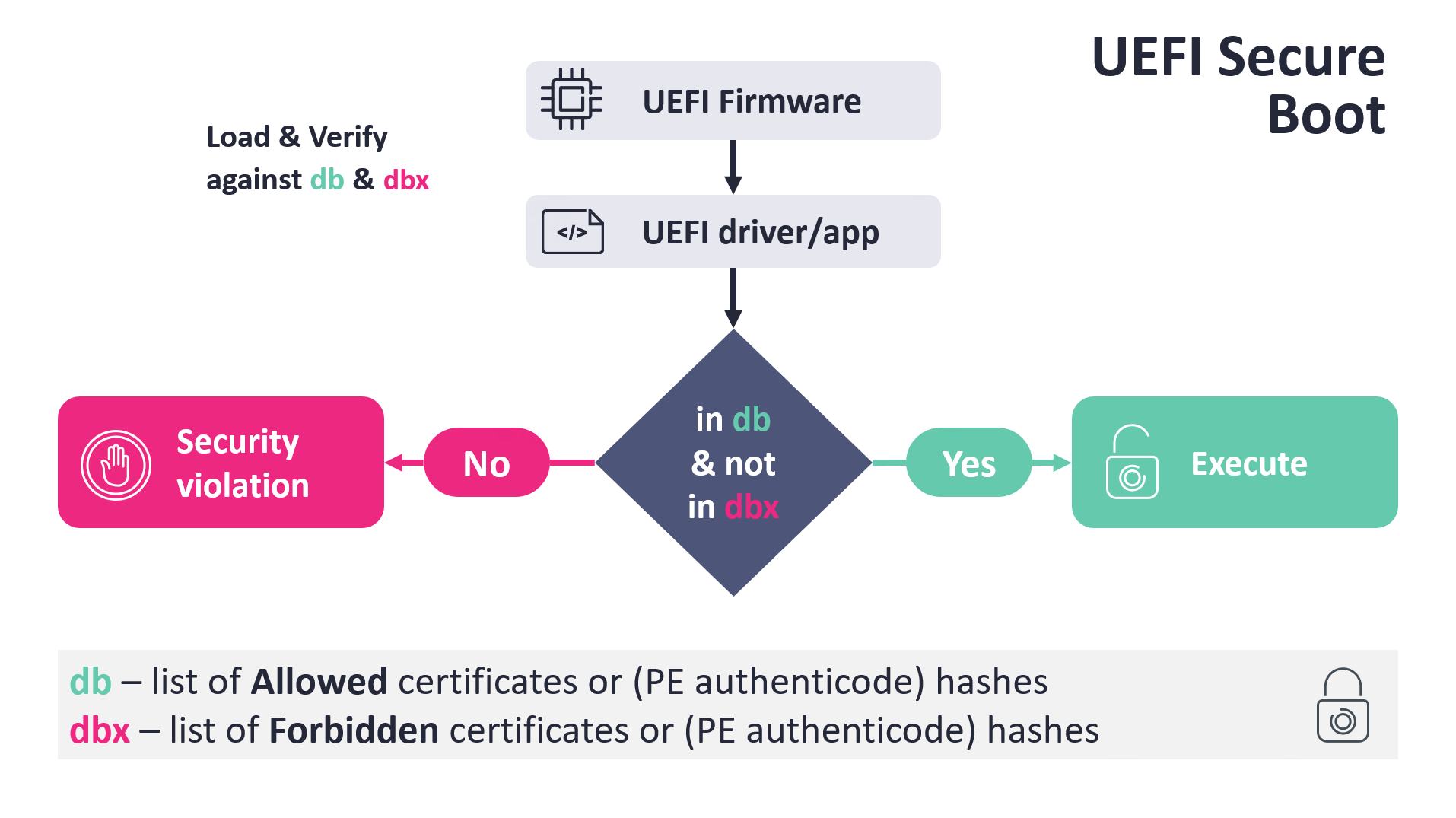
The image must be trusted by db and not listed in dbx – otherwise, the boot manager triggers a security violation instead of executing it. To make this work out of the box on newly purchased devices with UEFI Secure Boot enabled, most OEMs enroll a set of Microsoft UEFI certificates in the db database, namely:
- Microsoft Windows Production PCA 2011 and Windows UEFI CA 2023 (used to sign Microsoft’s own UEFI boot applications; the 2011 certificate will be added to dbx soon as a result of the BlackLotus-related vulnerabilities).
- Microsoft Corporation UEFI CA 2011 and Microsoft UEFI CA 2023 (used to sign third-party UEFI boot software, such as Linux shims, recovery tools, and disk encryption utilities).
This means that anyone wanting their boot-time software to be UEFI Secure Boot-compatible by default can submit their binaries to Microsoft for signing through the Windows Hardware Dev Center, and once approved, the signed files become trusted on the vast majority of UEFI systems.
Microsoft’s central role in securing most UEFI-based devices means that the company has the authority to determine what is allowed to run during boot. This is evident in the revocation process of UEFI Secure Boot, where Microsoft manages the forbidden-signatures database (dbx) to revoke vulnerable boot applications. While revoking individual binaries by hash was initially reasonable, recent incidents like BootHole highlight the limitations of this approach due to the scale of revocations. To address this issue, Microsoft and its partners have introduced version-based revocation mechanisms, such as Secure Boot Advanced Targeting (SBAT) and Secure Boot Security Version Number (SVN), which focus on revoking entire versions of vulnerable applications. This shift from revoking binaries to versions simplifies the process and ensures that all problematic builds are excluded from boot, improving overall security.
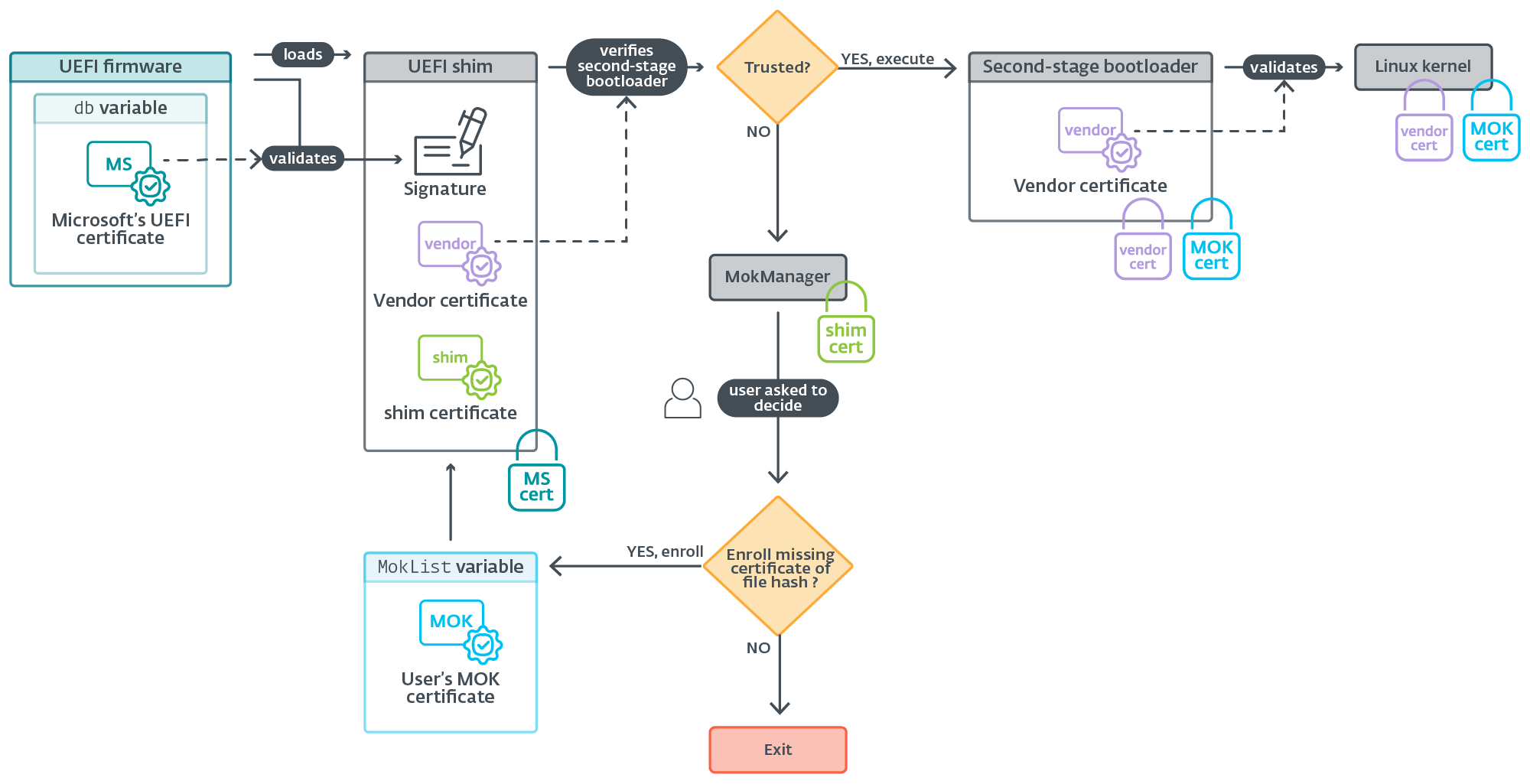
The UEFI boot flow on Linux systems with a Machine Owner Key (MOK) involves a series of steps for secure booting. First, the UEFI application supporting Secure Boot Advanced Targeting (SBAT) carries metadata in a dedicated .sbat section of its PE file. This metadata includes the component name and a generation number for security updates. A boot-only UEFI variable named SbatLevel records the minimum acceptable generation number for each component, managed and enforced by the shim.
At every boot, the shim verifies its own SBAT metadata against the policy and then applies the same test to every binary it loads, ensuring that only components meeting the generation number requirement are accepted. The shim embeds the policy for faster revocation updates compared to traditional methods.
SBAT revocations are maintained in a central repository, and the enforced level is visible to the operating system through the SbatLevelRT variable. However, the OS cannot modify this policy, ensuring the integrity of the bootloader.
Old shims that trust outdated second-stage bootloaders pose a security risk, as these binaries may contain vulnerabilities that can be exploited. For example, a GRUB 2 binary trusted by a shim may have known vulnerabilities, allowing an attacker to bypass Secure Boot restrictions. By exploiting these vulnerabilities, an attacker can execute non-verified code during system startup, compromising system security.
It is important for vendors to update their shims regularly to include security patches and prevent exploitation of known vulnerabilities. By staying up-to-date with the latest features and improvements in the UEFI shim repository, vendors can enhance the security of their systems and protect against potential threats.
This behavior is in line with the original design of shims, but there has been a lack of focus on revoking outdated Microsoft-signed shims, which can be exploited to bypass newer security measures. This gap is demonstrated through specific examples.
MOK denylist enforcement:
Support for MokList (MOK-based allowlisting) has been present in upstream UEFI shim since version 0.3, while MOK revocations (MokListX) were only enforced starting from version 0.9. This poses a problem in scenarios where enterprises revoke old signing certificates and enroll fresh ones, as outdated certificates can still be trusted in MokList but denied in MokListX, creating a security loophole.
SBAT enforcement:
Similar to MOK denylist, earlier shims are unaware of SBAT mechanisms introduced in version 15.3. Attackers can exploit this by pairing pre-v15.3 shims with revoked binaries, tricking the shim into loading vulnerable components without verification.
Known shim vulnerabilities:
Old shims may contain known vulnerabilities, such as the CVE-2026-10797 issue affecting shims at version 0.9 and below. This vulnerability allows attackers to bypass revocation checks by tampering with the WIN_CERTIFICATE structure, enabling the loading of vulnerable binaries without detection.
Expiration of Microsoft UEFI certificates:
Despite the expiration of Microsoft UEFI certificates, bootloaders signed with expired certificates remain trusted unless explicitly revoked. This highlights the importance of addressing vulnerable UEFI applications signed with expired certificates to prevent security risks.
Protection and detection
By applying the latest UEFI revocations from Microsoft, vulnerable shims can be blocked. Windows systems typically receive these updates automatically. To check if the necessary revocations are installed on your Windows system, you can run the following PowerShell commands with elevated permissions:
$hashes="AE75F0D82BA3DF824FBFC69340CC3B4D66C598373B1AB54CDB6C8BFD83A6B961",

'7B2A3F5C96F95BD8086CE54B0825E300F9C8F11FE3401BB631B3215C8DE9EB10',

'EB86FA1386FE6E4533B8B938DCC1250616D2F1C14C15E2FCF80834A161018A0A',

'FD23D6E57DE6F4E1F9D7118DA1C5F31A8AF6BE5E5D9E8170F9493447268D50C5',

'A0DE9333442C1BF9349A460141AE5E80F911955C6506040FA3D021BF6C1AE3E4',

'95B6D71FC0C0F8C5E1533A37AEF92CF6B0C961E2CC612A97117FA6759CE5FC06',

'236A9CB0D71951C36398A32EB660CE2CD4A52CCFA7CF751CC6A35D9DE549E19B',

'5E594C448760A3135B1A3A83E07A4F2E6FBE49414EF2C7CAB1CBA77F284FA63B',

'8A964D5F8373948D20A1D4296FB92E545DAD4617A0C810F3B934B53D98AE8963',

'410260B1B6F5AF5FBEEB9EA3220658435E876CB3247126EE907A437F312DB373',

'96275DFD6282A522B011177EE049296952AC794832091F937FBBF92869028629'

$dbx = [BitConverter]::ToString((Get-SecureBootUEFI dbx).Bytes) -replace '-'

$notRevoked = $hashes | Where-Object  $dbx -notmatch $_

if ($notRevoked)  ForEach-Object  "Hash not revoked: $_"

 else

    "All hashes revoked in dbx!"
Figure 6. PowerShell commands to check UEFI revocations
For Linux systems, updates should be available through the Linux Vendor Firmware Service. You can check the revocation status using the uefi-dbx-audit script.
If you want more recommendations on protecting against or detecting exploitation of unknown vulnerable signed UEFI bootloaders and UEFI bootkits, refer to our blogpost “Under the cloak of UEFI Secure Boot: Introducing CVE-2024-7344.”
Conclusion
The danger of these old shims lies not in a new vulnerability, but in the fact that bypassing UEFI Secure Boot does not require one. An attacker only needs an old, still-trusted but unrevoked shim binary and a basic understanding of UEFI shims to bypass this crucial security feature.
While revoking the 11 shims addressed the immediate issue, a larger problem persists: visibility. The shim signing process gained more transparency in 2017 with the shim-review repository, where vendor submissions undergo vetting before Microsoft signs them. However, older signed shims are not documented, making it unclear how many of these old, still-trusted shims are still in use. What is not cataloged transparently cannot be effectively retired.
Despite this, there is progress in the right direction. Each disclosure like this reduces the number of forgotten shims, and with enhanced shim-signing transparency and tools like SBAT, tracking and revoking vulnerable shims can be done more efficiently. The next step is to extend this transparency in Microsoft’s third-party UEFI signing ecosystem to non-shim third-party UEFI applications, which have also been shown to pose UEFI Secure Boot bypass risks.
IoCs
Since the vulnerable shims are part of legitimate software packages found on numerous uncompromised systems, we are not providing specific indicators of compromise to prevent widespread misidentification. Instead, we recommend following the guidance in the Protection and detection section.
If you have any questions about our research on WeLiveSecurity, please contact us at threatintel@eset.com.ESET Research provides private APT intelligence reports and data feeds. For inquiries about this service, visit the ESET Threat Intelligence page.
Rewrite the sentence in a more concise manner. rewrite the sentence as follows: “Could you please rephrase the sentence?”