
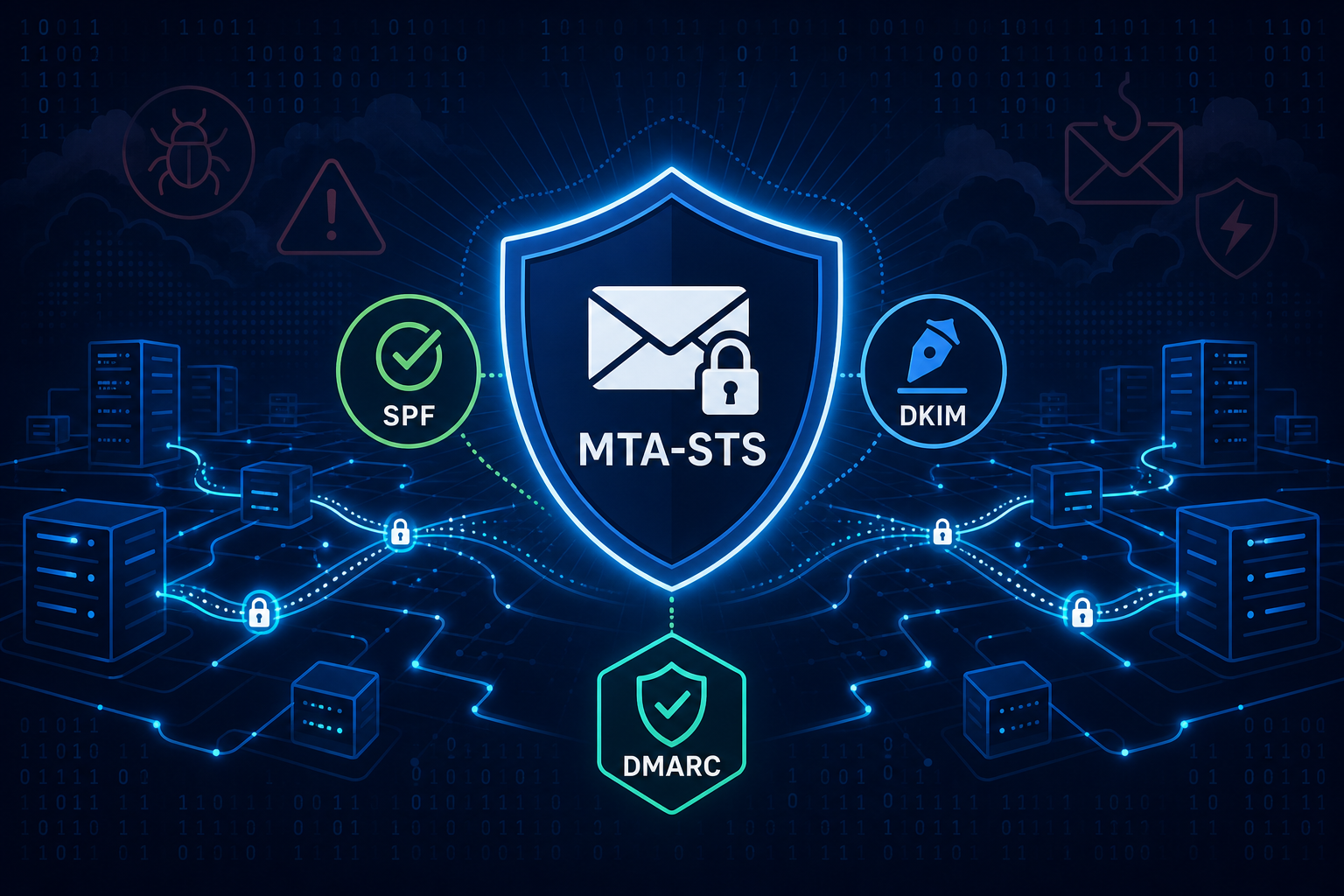
MTA-STS is a crucial aspect of email security that often goes unnoticed. It addresses the risk of intercepted or downgraded encrypted SMTP connections, especially as cyber threats like business email compromise (BEC), domain impersonation, and targeted phishing attacks continue to rise. Organizations now understand that email authentication alone is not enough to protect their communications.
The Hidden Vulnerability in Email Security
Most email servers rely on STARTTLS for encrypting SMTP traffic. However, STARTTLS is opportunistic, meaning that if encryption fails, systems may revert to unencrypted delivery. This exposes vulnerabilities that attackers can exploit.
Google highlights that standard SMTP is susceptible to man-in-the-middle attacks and lacks inherent encryption or certificate validation. MTA-STS addresses this weakness by mandating sending servers to validate certificates and utilize TLS encryption before sending emails.
Without MTA-STS, attackers can:
- Degrade encrypted SMTP sessions
- Intercept emails during transit
- Redirect emails through malicious MX hosts
- Take advantage of DNS spoofing attacks
These risks become particularly alarming when sensitive communications like invoices, legal documents, customer information, or executive correspondence are involved.
The Ongoing Impact of Business Email Compromise
The significance of securing email transport is evident when considering the financial toll of email-based attacks. Recent analyses show that Business Email Compromise (BEC) scams led to economic losses exceeding $2.9 billion in the previous year.
While DMARC helps combat direct domain spoofing, BEC schemes often exploit compromised mail flows, interception, and trusted communications. MTA-STS adds an extra layer of defense by ensuring messages are delivered to legitimate mail servers via authenticated TLS connections.
Low Adoption Rates Despite Security Benefits
Despite the security advantages it offers, MTA-STS adoption remains alarmingly low across the Internet.
A study tracking the top one million domains in 2025 revealed:
- Only 5,609 domains had implemented MTA-STS.
- Just 0.6% of the top 1 million domains had adopted the protocol.
- However, adoption saw a 54% year-over-year increase, from 3,630 domains in 2024 to 5,609 in 2025.
The study also found that among domains with valid configurations:
- 54.2% were in enforce mode.
- 44.8% were in testing mode.
These statistics reveal a paradox: while awareness is growing, most organizations are still leaving their email transport vulnerable.
Addressing the Disparity Between DMARC and MTA-STS Adoption
A comparison of DMARC and MTA-STS adoption rates underscores the industry’s oversight in email transport security. According to the 2026 U.S. Email Security Report:
| Technology | Adoption Rate |
|---|---|
| SPF | 95.7% |
| DMARC | 95.8% |
| DNSSEC | 18.0% |
| MTA-STS | 1.7% |
This indicates a strong emphasis on sender authentication at the expense of email transport security.
The report characterizes U.S. email security as a “two-tier system” where authentication controls are widely in place, but transport protections are lacking.
Critical Sectors Expose Vulnerabilities
Data from key industries paints a concerning picture:
Government
- SPF correctness: 97.7%
- DMARC reject enforcement: 80.1%
- MTA-STS adoption: 3.4%
Banking and Finance
- SPF correctness: 90.9%
- MTA-STS adoption: 3.0%
Industries that handle financial transactions, citizen information, and confidential communications lack adequate transport-layer encryption enforcement.
Common Configuration Pitfalls
Deploying MTA-STS is only effective if done correctly. Among domains implementing the protocol, common validation failures include:
- Missing A/AAAA records: 33.3%
- HTTPS certificate problems: 25.3%
- Secure connection failures: 5.7%
- Expired certificates: 5.6%
- Missing MX definitions in the policy: 5.5%
These findings underscore the importance of TLS-RPT in providing visibility into delivery and encryption failures alongside MTA-STS.
Enhancing Brand Protection with MTA-STS
While organizations invest in DMARC to combat brand impersonation, the focus on post-authentication security is often overlooked. Attackers can still manipulate DNS responses or tamper with SMTP sessions to compromise email delivery if transport security is not strictly enforced.
MTA-STS addresses this by:
- Requiring TLS encryption
- Validating server certificates
- Restricting delivery to authorized MX servers
- Preventing STARTTLS downgrade attacks
For organizations prioritizing domain protection, executive security, customer trust, and regulatory compliance, MTA-STS complements DMARC rather than replacing it.
As email authentication becomes standard practice, attackers increasingly target email transport vulnerabilities. MTA-STS bridges this crucial security gap by ensuring that authenticated emails are securely delivered. Organizations focused on robust email security should consider MTA-STS and TLS-RPT as essential components alongside SPF, DKIM, and DMARC.